The Canvas Gallery Wall: A Calm Guide to Arranging Photos at Home
A calm guide to building a canvas gallery wall at home — how to choose photos, lay out sizes, hang them cleanly, and let them settle into the room.
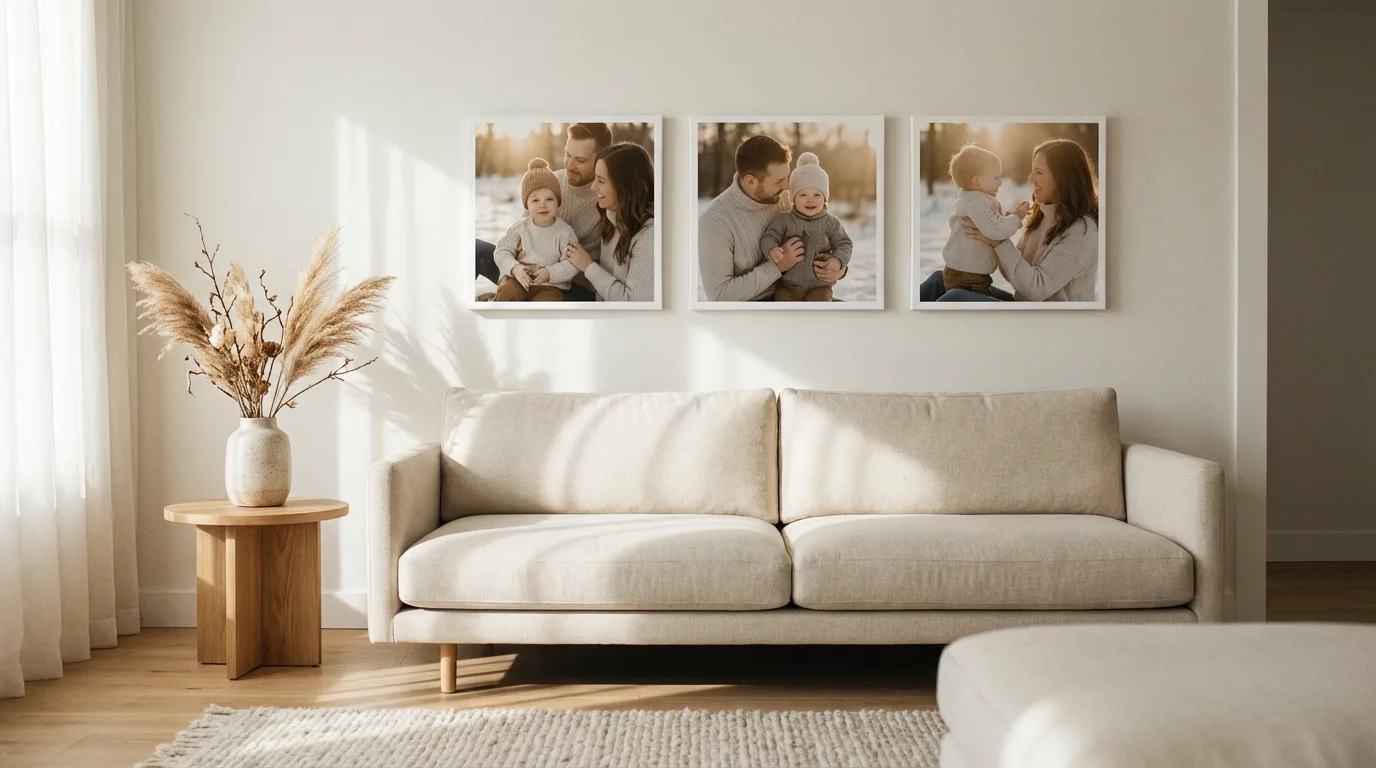
A gallery wall has a reputation it doesn't quite deserve. It sounds like a project — protractors, painter's tape, a Saturday afternoon that turns into a Sunday evening. In practice, the walls we return to are almost never the most ambitious ones. They're the quiet ones. A few photos that belong together, sized honestly, hung at a height the room wanted anyway.
This is a walk-through for building one of those quieter walls. It assumes you have a phone full of photos and a stretch of empty wall, and it takes you to the point where the canvases are up and the room has absorbed them. No listicle. No ten tips. Just the sequence, in order, the way someone with good taste would think about it.
Start with the wall, not the photos
The instinct is to pick the photos first. Resist it. The wall decides more than you think — its width, its light, what's below it, what's across from it. A wall above a low sofa wants a horizontal pull. A narrow wall at the end of a hallway wants vertical weight. A wall across from a window will shift color all day, which matters for prints more than people expect.
Stand in front of the empty wall for a minute. Notice the width you actually have — not edge to edge, but the honest visual zone, usually two-thirds of the wall. Notice what sits underneath it, because the gallery will read as a unit with whatever is below. A sofa, a console, a bed — the furniture sets the lower edge. Your canvases will feel grounded or ungrounded depending on how the two relate.
If the furniture below is busy — patterned, colorful, tall — the wall wants to be calmer. Fewer pieces, more breathing room between them. If the furniture is quiet, the wall can do more of the talking.
Choose photos the way you'd choose music
This is the hard part, and the reason most gallery walls end up feeling like a pile rather than a composition. Curation is the whole game.
Open your camera roll. Keep the photos that feel like they belong to the same album. Not the same trip, necessarily — the same feeling. Warm winter light. Slow mornings. One summer. A single child at one age. Two grandparents, always.
Set a soft cap: three to seven photos is the range most family gallery walls land in. Fewer than three and it stops reading as a gallery. More than seven and the eye gives up and starts treating it as wallpaper.
A few gentle filters that help:
The photos should share at least one through-line. Color temperature is the easiest — all warm, or all cool, or all slightly muted. Subject counts too: all people, or all places, or all one person across time. Without a through-line, the wall feels like a scrapbook.
Vary the distance. A wall made entirely of close-ups feels claustrophobic; a wall made entirely of wide shots feels impersonal. The mix is what gives it depth. One tight portrait, one middle-distance moment, one wider scene — three canvases already feels like a story.
Leave out the obvious. The posed holiday card shot is almost never the right pick. The better one is the photo you took twenty minutes before the posed one, when nobody was quite ready.
The three layouts that actually work
There are more arrangements than this, but most gallery walls reduce to one of three underlying shapes. Pick the one that fits your wall and your photos, not the other way around.
The grid
Equal canvas sizes, equal spacing, arranged in a rectangle — usually two-by-three or three-by-three. The grid is the most forgiving layout because the discipline is in the spacing, not the photo choice. It reads clean and editorial. It works especially well for a series — one subject at different ages, the same location across seasons, a trip photographed the same way each day.
The grid wants identical sizes. Mixing sizes inside a grid undoes the whole effect.
The salon
Mixed sizes, asymmetrical, clustered around an invisible center line. The salon is the hardest to get right and the most rewarding when it lands. It mimics the way museums used to hang paintings in the 1800s — a larger anchor piece in the middle, smaller ones radiating out, with no axis of symmetry.
The trick with a salon is to pick one anchor canvas roughly 40–50% larger than everything else, and to keep the spacing between pieces tight — two to three inches — so the cluster reads as one composition instead of a scatter.
The narrative line
A horizontal or vertical line of canvases, usually three to five, the same size, evenly spaced. A line is the calmest of the three and the most gallery-like. It works when the photos have a natural sequence — a timeline, a series, a set.
A line above a sofa is one of the quietest and most satisfying arrangements in home decor. It almost always works.
Sizing across the wall
Once you know the layout, sizing follows. A few rules of thumb that translate well from museum practice into real homes:
The total arrangement — all canvases plus the spacing between them — should cover roughly two-thirds of the furniture width below it. A 90-inch sofa wants an arrangement about 60 inches wide. Any narrower and the wall looks underweight; any wider and it feels crowded.
For a grid or a line, pick one canvas size and repeat it. Our small (20×30 cm) works for a grid of six; our medium (30×40 cm) for a line of three or four above a sofa; our large (40×60 cm) as a single anchor with smaller pieces around it.
For a salon, the anchor canvas is usually the medium or large size, and the satellites are smaller. A 40×60 cm anchor with three 30×40 cm satellites is a composition that works in almost any living room.
Resist the temptation to go larger than the wall actually wants. An oversized canvas on a small wall reads as a mistake, not a statement.
Lay it out before you touch the wall
This is the step people skip, and it's the step that saves the afternoon.
Before you put a single hole in the wall, lay the whole arrangement on the floor. Use the exact canvases, in the exact positions, at the exact spacing you plan to use on the wall. Photograph it from above. Look at the photo for five minutes. Move things. Photograph again.
The floor tells you things the wall won't tell you until it's too late. You'll notice that two similar colors are sitting next to each other. You'll notice that the anchor wants to shift an inch left. You'll notice that three canvases is right and four is one too many.
If you want to be extra careful, cut the layout in paper — butcher paper works, old newspaper works — tape the paper shapes to the wall with painter's tape, and live with it for a day. By the next morning you'll know.
Hanging, cleanly
The height rule is simple and nearly universal: the center of the arrangement should land at about 57 to 60 inches from the floor. That's the museum standard — it's the average human eye line, and it's why professionally hung walls feel correct without anyone being able to explain why.
For a gallery above a sofa or console, the lower edge of the bottom canvas should sit about 6 to 10 inches above the furniture. Closer than that and it crowds; further than that and the wall and the furniture stop speaking to each other.
Spacing between canvases sits in a two-to-three-inch band for most arrangements. Tighter — one to two inches — for a salon that should read as one unit. Wider — three to four inches — for a line that wants to breathe.
Use a level. Use a pencil. Put the nail or hook exactly where the math says. The canvases we ship come ready to hang with a sawtooth bracket on the stretcher frame — one nail per canvas is usually enough for our sizes, two for the large.
Let it settle
The finished wall will look slightly wrong for about a week. This is normal. The eye hasn't calibrated to the new visual weight yet, and small imperfections feel bigger than they are.
Don't adjust anything in the first week. Live with it. By the end of the second week, one of two things will have happened: either the wall will have become the part of the room you return to, or one specific canvas will have started bothering you. If it's the latter, it's almost always a single piece, not the arrangement as a whole. Swap that one and the wall clicks.
A gallery wall is not meant to be finished. It's meant to be finished enough to rest. You'll add one, eventually. You'll move one, eventually. That's what it's for.
Frequently asked questions
How high should a canvas gallery wall start from the floor? The center of the arrangement should sit at about 57 to 60 inches from the floor. For a gallery above a sofa, the lower edge of the bottom canvas usually lands 6 to 10 inches above the sofa back.
How many canvases do I need for a gallery wall? Three to seven is the range most family gallery walls land in. Fewer than three doesn't read as a gallery; more than seven and the eye stops composing and starts scanning.
Can I mix canvas and framed prints in the same gallery wall? Yes, but sparingly. A wall of canvases has a particular calm, matte quality. Adding a framed piece works if the frame is quiet — a thin black or light wood — and if there's only one of them. More than one framed piece among canvases starts to look unresolved.
Should all the photos on a gallery wall be the same size? For a grid or a line, yes. For a salon arrangement, no — that layout depends on size variation, with one anchor piece roughly 40–50% larger than the others.
How far apart should canvases be on a gallery wall? Two to three inches is the standard spacing. Go tighter (one to two inches) for a salon that should read as a single unit; go wider (three to four inches) for a line that wants to breathe.
What's the best way to plan a gallery wall before putting holes in the wall? Lay the arrangement on the floor in the exact positions and spacing you plan to use, photograph it from above, and adjust from the photo. For a stricter pass, cut paper templates, tape them to the wall, and live with them for a day before committing.
When you're ready
If you already know which photos belong together, you can start a gallery wall with three canvases and add as the wall tells you to. Our small and medium canvases are the two sizes that do the most work in a family gallery. If you'd like a second pair of eyes on your selection, you can send us the photos and we'll sketch a layout back.
Walking into a room with the wall already settled is one of the quiet pleasures of a well-put-together home. It's worth the extra afternoon.