Pet Memorial Canvas: A Quiet Way to Keep Them Close
A thoughtful guide to turning pet photos into canvas prints—photo selection, sizing, and the quiet way they sit in your home.
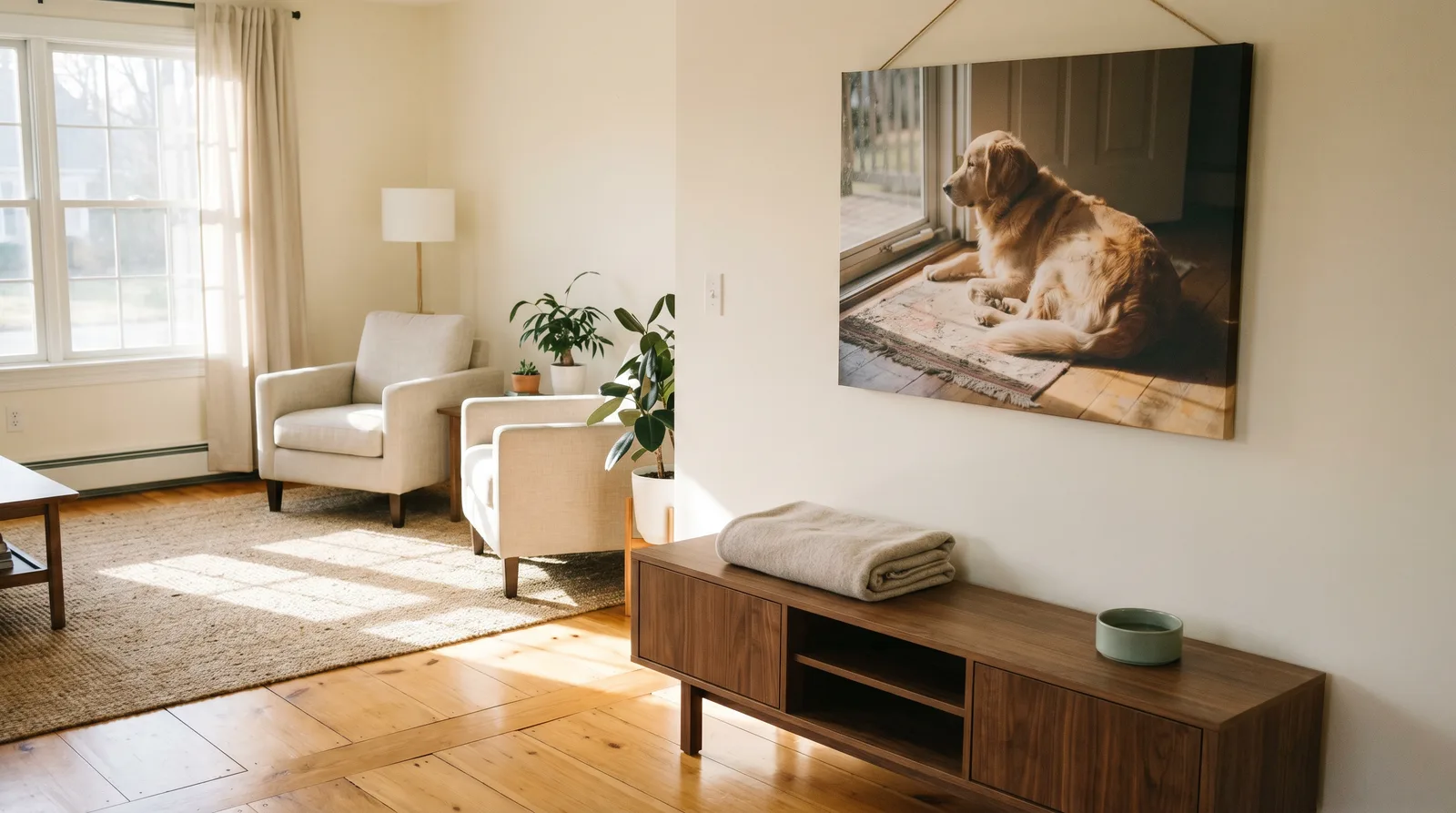
In Memoriam · Guides
The absence is what you notice first—the empty bed, the corner of the room where she always napped, the spot by the door where he waited for your shoes to come on. A pet memorial canvas doesn't fill that absence. Instead, it sits quietly on your wall, holding the image of them as they were—the light they stood in, the way they turned their head, the moment just before they knew the camera was there. It's a way to keep their presence in the room without trying to replace what's gone.
By the Photumo team · April 28, 2026
What makes a memorial canvas different
A memorial canvas isn't just a printed photo on cloth. It's made to last—stretched on a solid internal frame, printed with UV-resistant inks, and finished with a matte surface that won't reflect light into the room. This matters because you're not making something to display for a few weeks. You're creating something that will sit on your wall for years, holding the image steady.
The construction is quietly important. Hand-stretched cotton canvas breathes slightly as the seasons change, so a solid pine frame keeps it from warping. A matte finish doesn't show dust or fingerprints the way glossy paper would, and it ages more gracefully—the image looks stable year after year, not like it's fading. The hardware comes attached, so the canvas goes straight to the wall.
Unlike an urn or a plaque, a canvas doesn't announce itself as a memorial. It just hangs there, as natural as a family photo, which is partly what makes it work. People who visit your home won't see it as a sad thing on your wall. They'll see a beautiful image of a pet who clearly mattered to you.
The room without them, and what belongs there
When you first think about hanging a memorial canvas, the question isn't "where should I put it?" It's "what does this room look like now?" After a pet dies, their absence becomes part of the room's geography. The favorite spot on the sofa is empty. The corner by the window is too quiet. The hallway doesn't smell the same. A memorial canvas acknowledges that change. It doesn't pretend the pet is still there, but it does say: "This one mattered."
Where you hang it depends on the room and what feels honest. Many people hang a memorial canvas in a hallway—a quiet spot where you pass it daily, but it's not the focal point of a room where you're entertaining or working. Others put it in a bedroom or study, somewhere private. Some choose a living room wall, making the memorial as visible as any other family photo. There's no right answer, only what feels right to live with.
| Room type | Suggested size | Why it works |
|---|---|---|
| Hallway | 12×16" or 16×20" | A quiet focal point, noticeable but not dominating. Easy to see daily without it being the first thing guests encounter. |
| Above a console or desk | 16×20" or 20×30" | The surface below anchors it visually. Creates a small shrine-like moment that feels intentional, not accidental. |
| Bedroom wall | 12×16" or 16×20" | Private space for a personal memorial. Often positioned where you see it before sleep, or when you first wake up. |
| Living room (above sofa) | 20×30" or 24×36" | A larger canvas works here. Treated like a family portrait, as valid as any other photo in the home. |
Choosing the right photo
The best memorial photo isn't often the one you thought it would be. Most people, when they first start looking, reach for the "perfect" photo—the one where the pet looks alert, directly at the camera, or posed in a flattering way. But after a day or two, they find themselves drawn to something else: a candid shot, the mid-nap angle, the way the light caught their fur, the moment they were turning their head away.
These unguarded moments tend to last better on a wall. They feel more alive because they capture the pet as they actually were—not dressed up for a portrait, but just being themselves. The photo that keeps catching your eye is usually the right one. You might find it while scrolling through your phone, or in a folder labeled "Random" that you haven't opened in months. Sleep on the choice for a day. If it still feels right, that's your answer.
Resolution matters less than people worry. Photographs taken on any smartphone in the last 10 years will print beautifully at standard canvas sizes. If you're working with an older photo or one from a camera, a matte finish helps soften any graininess. You can also ask the printer's support team—most will upscale a lower-resolution image and use subtle texture to keep it looking natural rather than pixelated. The worst that happens is you're surprised by how good it looks.
Pet ownership in the United States is nearly universal: over 67% of U.S. households own a pet, with dogs and cats comprising the vast majority, according to the American Pet Products Association. When a pet dies, the grief is real and often underestimated by people who haven't experienced it. A memorial canvas respects that grief by creating a space for it in your home—not hidden away, but present and acknowledged.
Size and how light changes everything
Canvas size works differently than framed prints. A smaller canvas—12×16 inches—feels intimate, almost like a private conversation between you and the image. A larger one—20×30 or 24×36 inches—commands the wall and becomes a statement piece. Neither is better. It depends on the room and what kind of presence you want the memorial to have.
The wall itself matters too. Measure the space. In a narrow hallway, a 12×16 or 16×20 inch canvas is usually right. In a living room with high ceilings, it can feel small unless you go to 20×30 or larger. When in doubt, go slightly bigger than your instinct says. It's rarer to regret a canvas being too large than too small.
Light changes the way a canvas looks throughout the day. Morning light softens the image and brings out warm tones. Afternoon light can wash it out if it's directly facing the sun. Evening light is gentle and makes the matte finish glow slightly. Position your canvas where it gets indirect or ambient light—away from windows that get strong sun. This protects the inks and keeps the colors stable for years. If your memorial canvas is in a bright room, rotating it to a different wall seasonally can extend its life and keep you from getting tired of seeing it in the same light every day.
| Canvas size | Best wall width | Visual effect |
|---|---|---|
| 12×16" | 30–40" wide | Intimate, quiet. Feels like a small window into their world. Good for narrow halls or small bedrooms. |
| 16×20" | 40–60" wide | Balanced. Noticeable but not overwhelming. Works in most rooms. |
| 20×30" | 60–90" wide | More presence. The photo becomes a focal point. Right for living rooms or above a larger piece of furniture. |
| 24×36" | 80"+ wide | Bold, statement-making. Fills a wall. Only in spacious rooms with high ceilings. |
How to order your pet memorial canvas in 7 steps
Step 1: Choose your photo. Go through your phone, camera roll, or physical prints. The photo that keeps catching your eye is the one. It doesn't need to be perfect—candid, mid-movement, an odd angle—these often work best because they feel most like the pet.
Step 2: Check the image quality. Make sure the file is at least 2MB and taken on a reasonably recent device. Smartphone photos from the last decade print beautifully. If you're using an older or scanned photo, a matte finish masks any graininess. Upload it to your computer to get a larger view and confirm it looks clear.
Step 3: Decide on size. Measure or visualize the wall. Hallway? Go 12×16 or 16×20. Living room above a sofa? 16×20 or 20×30. When in doubt, slightly larger feels better than slightly smaller. A memorial canvas should feel intentional in the space.
Step 4: Add text if you want it. If you're including a name, date, or a word, keep it minimal and positioned in a corner, not across the image. Write down exactly what you want so there's no confusion when placing the order.
Step 5: Upload and preview. Visit the canvas printer's website, upload your photo, and check the preview at your chosen size. Most services show exactly how it will look. Adjust color or brightness if needed. The preview is your chance to catch anything unexpected before production.
Step 6: Place your order. Choose a matte finish (recommended—it doesn't show dust and ages gracefully). Confirm the production timeline (usually 3–5 working days) and shipping method. The canvas will come ready to hang with hardware included.
Step 7: Hang with intention. When it arrives, let it acclimate to your home for a day. Choose a spot with indirect light. Step back and see how it feels on your wall. If it's right, you'll know—the room suddenly feels like it's supposed to look this way.
Frequently asked questions
How can I turn my pet's photos into a memorial canvas after they pass away?
Upload your chosen photo to a canvas print service, select your size and finish, and the printer handles the rest. Most services take 3–5 working days to produce your canvas, then ship it ready to hang. Look for a printer that offers matte finishes and UV-fade-resistant inks—these keep the image stable over years. You'll receive your canvas stretched on an internal frame, ready for your wall.
What photo should I choose for a pet memorial canvas?
The photo that keeps catching your eye. It might be candid—mid-jump, mid-nap, the light he stood in most often—rather than a posed shot. Consider whether you want full-body or a closer detail (paws, face, the way she turned her head). The best memorial photo is one that feels like them, not a trophy image.
How long do custom canvas prints last before they fade or show signs of wear?
A high-quality canvas with UV-resistant inks and matte finish will remain vibrant for many years indoors, especially away from direct sunlight. Matte finishes naturally mask minor dust and don't reflect light into the room, keeping the image stable-looking over time. If your canvas is in a room with strong afternoon sun, rotate it annually or position it on an adjacent wall to extend its life further.
What's the best size for a pet memorial canvas in a hallway or living room?
In a hallway, a 12×16 or 16×20 inches creates a quiet focal point without overwhelming the space. In a living room, 16×20 or 20×30 inches works well above a sofa or console. The rule is: the larger the wall, the larger the canvas. Step back and imagine the empty wall—the canvas should feel like it belongs there, not like you're filling a gap.
Should I include text or just the photo on a memorial canvas?
This is entirely personal. Many people prefer the photo alone, letting the image speak. Others add a name, date range, or a brief word—usually small, in one corner, not as a banner. If you do add text, less is more. A name and a year is often enough. Think about what will feel right to live with for years, not just in the immediate moment.
How do I print a memorial canvas if my photos are old or low resolution?
Start by scanning physical prints at 300 DPI (dots per inch) if you have them. For digital photos, check the file size in your phone or computer—images 2MB or larger usually print well at standard sizes. If your photo is small or pixelated, ask the printer's support team; many can upscale or add subtle texture to keep the image soft. A matte finish also helps mask graininess that a glossy print would show.
Is it appropriate to give a pet memorial canvas as a sympathy gift?
Yes, if you know the person well and have a good photo of their pet. A canvas is more thoughtful than a sympathy card because it's meant to sit in their home as a quiet presence—not a reminder of loss, but an acknowledgment that the pet mattered. Present it without ceremony. 'I thought of him when I saw this' is enough.
Related guides
- Personalized pet photo wall art — How to display multiple pet photos in a cohesive way.
- How to hang a gallery wall — The principles behind arranging canvas prints on your wall.
- Choosing the right photo for canvas — Technical guidance on photo selection for any canvas print.
- Matte vs. glossy canvas prints — Why finish matters for longevity and aesthetic.
- Pet portrait styling ideas — Ideas for incorporating memorial or celebration canvas prints throughout your home.
- Canvas print care and longevity — Practical maintenance to protect your memorial canvas over time.